What Is a Customer Data Platform (CDP)?
A customer data platform (CDP) is a software system that collects, organizes, and unifies data from multiple sources. Imagine social media channels, email activities, and CRM data as multiple puzzle pieces. CDP puts them together to create a full picture of each customer profile.
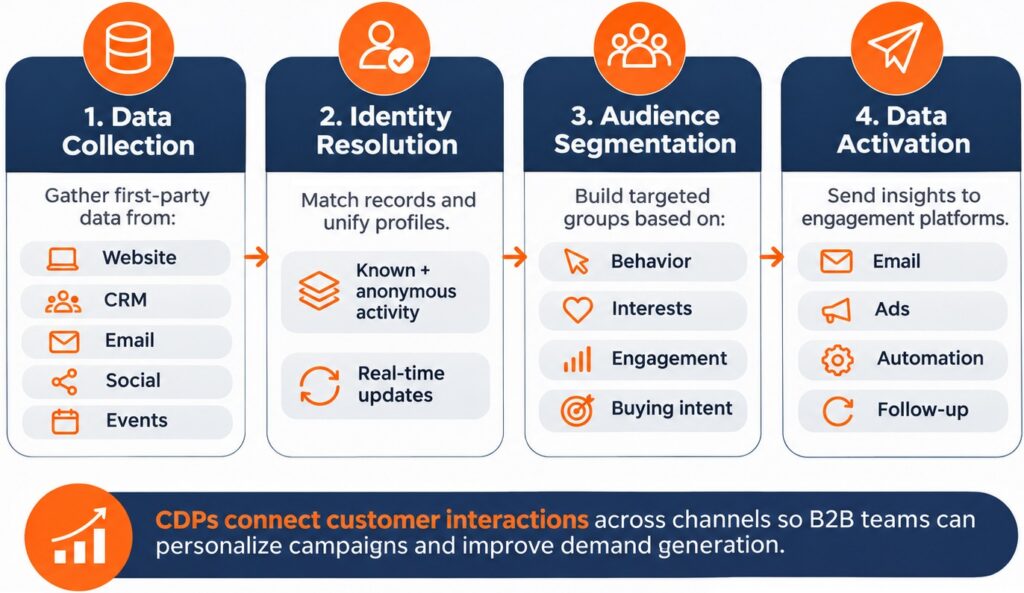
How a B2B Customer Data Platform Works Behind the Scenes
Customer data often lives across disconnected systems, from your website and email marketing software to your CRM and social media platforms. These data silos make it difficult to understand how prospects interact with your business throughout the buyer journey.
A B2B customer data platform (CDP) provides a centralized solution. It collects first-party data from multiple sources, consolidates customer identities, and organizes information into unified customer profiles. With a clearer picture of each prospect’s interactions, your marketing team can develop more relevant audiences, personalize campaigns, and improve demand generation.
A CDP typically works through four core capabilities:
1. Customer Data Collection
A CDP collects customer and prospect data from various user touchpoints, including your website, CRM, email marketing system, social media campaigns, and customer service platforms.
This information may include website visits, content downloads, form submissions, email engagement, and interactions with advertising campaigns.
For example:
A potential B2B customer clicks a LinkedIn ad, browses your website, downloads a product brochure, and later opens a follow-up email. The CDP collects these interactions from connected systems, helping your marketing team understand which topics and solutions interest that prospect.
2. Data Consolidation and Identity Resolution
Collecting data is only the beginning. A CDP also cleans, organizes, and connects information from multiple sources to create unified customer profiles.
Through identity resolution, the platform identifies records that belong to the same person and combines them into a more complete customer profile. Depending on the CDP’s capabilities and available identifiers, it can connect known information, such as email addresses and CRM records, with previously anonymous website interactions.
Some platforms also support real-time profile updates, allowing marketing teams to work with more current customer insights.
For example:
A prospect visits your website several times before completing a contact form. If the CDP can reliably connect their earlier browsing activity with the information they submit, it can consolidate those interactions into one profile.
3. Audience Segmentation
With unified customer profiles, a CDP helps B2B marketers segment audiences by behavior, interests, engagement history, and buying intent. Instead of sending the same message to every contact, you can create targeted audience groups and deliver more personalized, timely communications at scale.
For example:
A prospect repeatedly visits your cybersecurity product pages, downloads an anti-ransomware guide, and attends a related webinar. Your CDP can help identify these buying signals and place the prospect in a cybersecurity audience segment. Your marketing automation system can then send relevant product updates, educational resources, and offers based on their interests and stage in the buyer journey.
4. Customer Data Activation for Engagement
Once the CDP creates unified customer profiles and segments audiences according to your criteria, it can send that information to connected engagement platforms, including email marketing systems, advertising networks, and marketing automation tools.
This process, known as customer data activation, allows your marketing team to turn customer insights into targeted campaigns, automated follow-ups, and more relevant interactions across multiple channels.
For example:
A group of prospects attends your webinar on cybersecurity risk management. After the event, your CDP can identify attendees and activate that audience in your email marketing platform. You can then automatically send a thank-you email recommending a related training course or service based on the webinar topic and their previous engagement.
This creates opportunities for relevant cross-selling while keeping your follow-up communications connected to each prospect’s demonstrated interests.
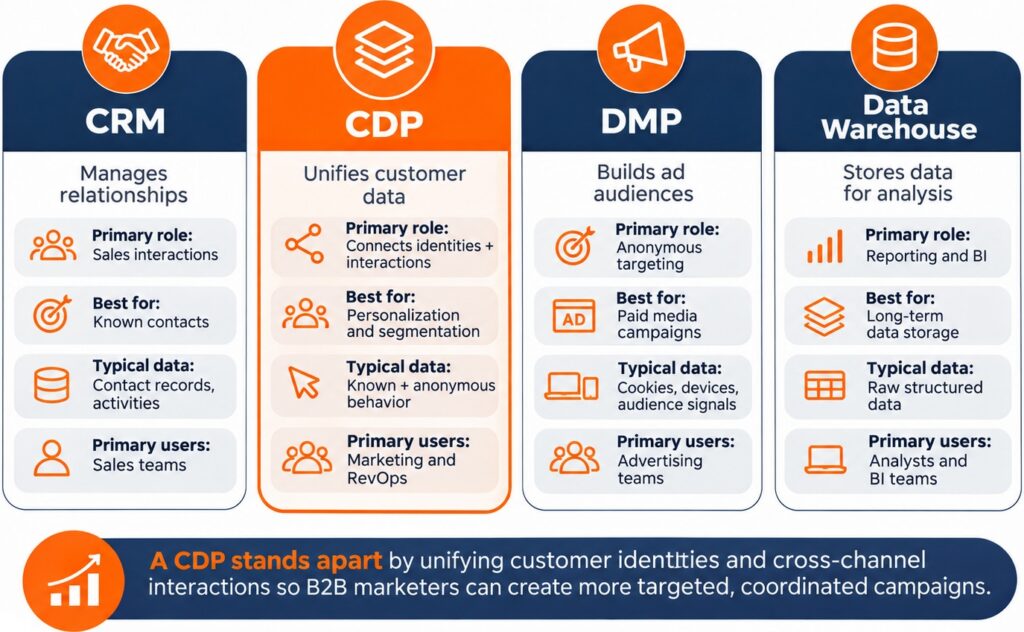
How Is a CDP Different From CRMs, DMPs, and Data Warehouses?
Customer data platforms (CDPs), customer relationship management (CRM) systems, data management platforms (DMPs), and data warehouses all help businesses manage customer data. However, each serves a different purpose.
Each platform plays a different role in managing customer data:
- CRM: Manages relationships and interactions with known customers and prospects.
- DMP: Supports advertising by targeting anonymous audience segments.
- Data Warehouse: Stores large volumes of data for reporting and analysis.
- CDP: Unifies customer identities and interactions across systems, helping your marketing team create more personalized, targeted, and coordinated campaigns.
Examples of Popular CDP Platforms
Not all customer data platform software works the same way. Some CDP solutions focus on connecting data from multiple sources, while others emphasize customer analytics, marketing automation, or personalized engagement.
The right CDP platform for your B2B marketing team depends on your existing technology, data management needs, and demand generation goals. Here are some popular CDP platforms worth exploring.

Twilio Segment
Twilio Segment is a developer-friendly customer data platform that collects, organizes, and activates first-party data across multiple tools. Its extensive integrations make it useful for businesses managing customer information across marketing, sales, and analytics systems.
- Key strength: Flexible integrations and developer tools that help businesses connect their existing technology without rebuilding their entire data infrastructure
- B2B application: Connect website engagement, product usage, and CRM data to create more complete customer profiles and improve audience targeting.

Adobe Real-Time Customer Data Platform
Built on Adobe Experience Platform, Adobe Real-Time CDP unifies customer data from multiple channels into actionable profiles. It supports advanced audience segmentation, data governance, and integration with Adobe’s analytics and customer experience tools.
- Key strength: Enterprise-level customer data management, real-time personalization, and advanced analytics within the Adobe ecosystem.
- B2B application: Combine customer and account-level information to identify high-value audiences, personalize marketing campaigns, and coordinate engagement across a complex buyer journey.

Salesforce Data 360 (Formerly Salesforce CDP)
Salesforce Data 360 brings together customer information from Salesforce products and external data sources. Formerly known as Salesforce Data Cloud, it supports identity resolution, unified customer profiles, audience segmentation, and data activation.
- Key strength: Native integration with Salesforce's sales, service, marketing, and automation capabilities.
- B2B application: Combine account records, sales activities, and marketing engagement data to identify opportunities, improve lead nurturing, and coordinate marketing and sales follow-ups.

HubSpot Data Hub
HubSpot Data Hub helps businesses connect, clean, and organize customer data across their technology systems. Working alongside HubSpot Smart CRM, it offers approachable data management tools that let marketers build unified datasets and use them for audience segments, reports, and automated workflows.
- Key strength: Accessible data management and activation tools that integrate directly with HubSpot's marketing, sales, and CRM capabilities.
- B2B application: Combine CRM records with data from external sources to improve lead segmentation, personalize email campaigns, and support marketing automation without extensive technical resources.
Niche and Industry-Specific CDP Solutions
Some customer data platform solutions are designed around particular industries or marketing requirements.
For example, 6sense focuses heavily on B2B revenue intelligence. Its data capabilities help businesses deanonymize account traffic, identify buying signals, and deliver targeted account-based campaigns to entire buying committees.
- Key strength: Predictive analytics and intent data integration designed specifically for complex B2B sales cycles.
- B2B application: A B2B enterprise could use these capabilities to identify which target accounts are actively in-market, prioritizing outreach for sales before a prospect ever fills out a form.
Ultimately, the best customer data platform is not necessarily the one with the most features. It is the one that fits your existing systems, improves data quality, and helps your team turn customer insights into qualified leads and more effective B2B marketing campaigns.
How a CDP Helps B2B Marketers Improve Marketing Performance
B2B buyers interact with your business across multiple channels before purchasing. A customer data platform brings these interactions together. It helps your marketing team understand buyer behavior, personalize campaigns, and make better demand-generation decisions.
Improving Marketing Attribution with Unified Customer Data
Through data collection and identity resolution, a CDP platform provides a clearer picture of the buyer journey. When paired with attribution tools, this unified data supports multi-touch attribution, helping you identify which marketing channels influence conversions.
For example:
A prospect clicks a Google search ad, goes through your landing page, and leaves. A few days later, they open a sponsored link on YouTube and visit your website. They then request a consultation. Marketing attribution with CDP data helps your team evaluate how these touchpoints contribute to the conversion rather than crediting only the final interaction.
- B2B benefit: Identify influential campaigns and allocate your marketing budget more effectively.
Enhancing B2B Audience Targeting and Personalization
A CDP uses unified customer profiles to segment prospects by behavior, interests, company characteristics, and engagement history. These customer insights support more precise CDP targeting and personalized marketing across connected channels.
For example:
Early-stage prospects: Receive educational content about your solutions.
High-intent prospects: Receive case studies, product comparisons, or consultation invitations.
- B2B benefit: Deliver relevant messages at the right stage of the buyer journey to improve engagement and lead nurturing.
Optimizing Campaign Performance with Better Customer Insights
By combining customer behavior and engagement data, a CDP helps marketers understand how campaigns perform. Integrated analytics tools provide real-time insights to refine audience segments, messaging, and calls to action.
For example:
Your email campaign generates high open rates but few website visits. With CDP analytics and connected reporting tools, you can compare engagement across audience segments and adjust your messaging to improve results.
- B2B benefit: Make faster, data-informed campaign decisions that improve marketing efficiency.
Supporting First-Party Data Privacy and Compliance
A CDP helps centralize first-party data. When integrated with consent management tools, it can support customer privacy preferences across marketing platforms. These capabilities support broader GDPR and CCPA compliance efforts, although the platform alone does not guarantee regulatory compliance.
For example:
A prospect opts out of personalized advertising but remains subscribed to your newsletter. Connected systems can use these preferences to restrict advertising data sharing while maintaining permitted email communications.
- B2B benefit: Support responsible customer data management, respect privacy preferences, and build customer trust.
B2B Use Cases: How CDPs Transform Marketing Operations
A B2B customer data platform helps marketing teams turn customer insights into actionable strategies. Here are three practical ways businesses can use CDPs to improve demand generation.
Use Case 1: Improving Lead Scoring and Nurturing
Scenario: A B2B software company generates leads through website forms, downloadable resources, and webinars. However, its marketing team struggles to identify which prospects are ready to talk to sales.
How the CDP helps:
- Unifies prospect data from website activity, email engagement, and CRM records.
- Provides behavioral insights that improve lead scoring models.
- Activates customer segments in marketing automation systems to trigger personalized nurturing campaigns.
- Business outcome: Better lead prioritization, more relevant nurturing, and improved sales efficiency.
Use Case 2: Strengthening Account-Based Marketing (ABM)
Scenario: An industrial equipment manufacturer targets enterprise accounts where engineers, purchasing managers, and executives influence purchasing decisions. Its marketing team needs to understand how these stakeholders engage with the company.
How the CDP helps:
- Connects individual customer profiles to their respective business accounts.
- Combines engagement data from multiple decision-makers to identify account-level buying signals.
- Supports targeted ABM campaigns tailored to different stakeholders and their interests.
- Business outcome: More focused account-based marketing, stronger engagement with buying committees, and better prioritization of high-value opportunities.
Use Case 3: Improving Sales and Marketing Alignment
Scenario: A B2B professional services firm generates leads through digital campaigns, but its sales representatives have limited visibility into prospects’ previous marketing interactions.
How the CDP helps:
- Unifies customer data from CRM, email marketing, website analytics, and other connected platforms.
- Gives sales and marketing teams a shared view of prospect engagement.
- Helps coordinate lead handoffs and follow-up communications based on customer behavior.
- Business outcome: Stronger sales and marketing alignment, more informed sales conversations, and smoother lead handoffs.
By connecting customer insights with marketing automation and sales processes, your team can prioritize qualified leads, personalize account engagement, and coordinate demand generation efforts more effectively.
Note: These are illustrative B2B scenarios, not documented customer case studies. Results depend on the CDP’s capabilities, integration quality, and the connected marketing and sales systems.
Challenges of Implementing a Customer Data Platform (CDP)
Implementing CDP software involves more than connecting your marketing tools. It requires clean customer data, the right technical resources, and cross-team collaboration.
Understanding these common implementation challenges can help you plan a smoother transition and get more value from your investment.
| Implementation Challenge | Why It Matters | Recommended Solution |
|---|---|---|
| Data Silos and Integration | Customer data is scattered across CRMs, websites, marketing automation tools, and other platforms. Inconsistent records make customer data unification difficult. | Audit your data sources, establish data quality standards, and prioritize essential customer data platform integrations. |
| Cost and Technical Complexity | CDP implementation may involve software licensing, data preparation, system integration, and ongoing maintenance. | Define your budget and priority use cases. Start with essential features and expand implementation in phases. |
| Team Adoption and Training | Marketing, sales, and IT teams may have different workflows or lack experience using unified customer profiles. | Involve stakeholders early, assign clear responsibilities, and provide practical training focused on everyday tasks. |
| Measuring CDP Performance | Without defined goals, businesses may struggle to determine whether their CDP investment improves marketing outcomes. | Establish KPIs such as data quality, qualified leads, audience engagement, and marketing efficiency before implementation. |
How to Overcome CDP Implementation Challenges
You do not need to connect every data source or activate every CDP feature immediately. A phased approach helps your team manage complexity while building toward more advanced B2B customer data management.
Consider these steps:
- Start with one high-value use case. Focus on a measurable goal, such as improving lead scoring, audience segmentation, or account-based marketing.
- Prioritize data quality. Identify the first-party data needed for that goal and resolve duplicate records, inconsistent formats, and incomplete customer information.
- Implement in phases. Begin with essential CRM and marketing automation integrations before expanding to additional channels.
- Get the right expertise. Work with experienced consultants or implementation specialists when your team needs support with technical setup, data governance, or customer data activation.
- Train your teams and measure results. Help marketing and sales teams use customer insights effectively, then evaluate performance against your original KPIs.
- Business outcome: Stronger sales and marketing alignment, more informed sales conversations, and smoother lead handoffs.
Successful CDP implementation starts with a clear business objective, not the technology itself.
Why B2B Marketers Should Consider a CDP
A customer data platform can help your B2B marketing team move beyond disconnected data and make smarter marketing decisions. By unifying first-party data, a CDP provides clearer customer insights, improves marketing attribution, and supports more personalized campaigns that generate qualified leads.
However, implementing CDP software requires the right strategy, investment, and a prepared team. The best approach is to start with one high-value use case.
At Zipline B2B Marketing, we help you evaluate how a CDP fits into your existing marketing strategy and identify practical opportunities to improve demand generation. From exploring CDP demo options to planning your first customer data platform integration, we can help you determine the right next steps for your business.
Ready to put your customer data to better use?
Schedule a consultation with Zipline B2B Marketing to explore CDP options and build a more connected, data-driven marketing strategy.
Frequently Asked Questions About Customer Data Platforms (CDPs)
A CRM manages relationships with known leads and customers, tracking sales activities and interactions. A customer data platform (CDP) unifies known and anonymous customer data from multiple sources to create more complete customer profiles that support audience segmentation, personalization, and marketing automation.
Zipline B2B Marketing can help you explore CDP software options, evaluate your existing marketing systems, and plan customer data platform integration around your demand generation goals. Schedule a consultation to discuss your data management needs and determine the right next steps.
Not always. Small businesses with simple customer data management needs may find their existing CRM and marketing automation tools sufficient. However, a CDP may be worth considering when disconnected data sources limit personalization, lead scoring, and campaign performance.
CDP implementation timelines depend on your data quality, integration requirements, and technical resources. A limited use case may take a few weeks, while complex enterprise implementations can take several months. Starting with essential integrations can help your team manage costs and complexity.
Industries with complex customer journeys and multiple data sources often benefit from CDPs. These include B2B manufacturing, technology, professional services, healthcare, financial services, and eCommerce. CDPs help these businesses unify customer data, improve targeting, and deliver more personalized experiences.